
AI data-driven modeling
Simulate complex “what-if” scenarios in real-time with AI and machine learning.


Govern data, train AI models and accelerate design predictions
ESTECO AI/ML Technology helps you build computationally efficient surrogate models to accelerate exploration of complex design spaces faster. By leveraging machine learning algorithms for engineering simulation, you can train response surface models (RSM) for rapid data-driven modeling and reduced order models (ROM) for explainable AI through dimensionality reduction.
What is AI data-driven modeling?
Our approach uses techniques like proper orthogonal decomposition (POD) to extract key features from high-fidelity simulation data. This allows you to create models that predict system behavior in real time, accelerating design exploration. By evaluating hundreds of alternatives in a fraction of the time required for traditional simulations, you can democratize access to simulation-driven insights across engineering teams.

modeFRONTIER AI/ML data flow
modeFRONTIER’s process automation and design optimization software enables subject matter experts to perform AI/ML data-driven modeling tasks for rapid design predictions — even without a background in data science.
- ML algorithms for RSM training
Exploit existing datasets to train effective metamodels. - Python for ML data-driven predictions
Integrate external libraries for custom analysis. - Explainable AI through reduced order models (ROM)
Simplify AI adoption through dimensionality reduction.
Leverage modeFRONTIER to predict designs faster
Learn moreML algorithms for response surface models (RSM) training
Use modeFRONTIER’s ML algorithms to turn existing simulation and experimental datasets into effective metamodels for RSM-based optimization. Our automatic machine learning (AutoML) algorithm ensures you can build the high-performance surrogate models without being an AI expert. It automates the process of selecting, configuring, and deploying the optimal predictive model for your specific engineering data. AutoML excels with high-volume data by systematically evaluating a wide array of RSM techniques to identify the best fit. It also automates validation and regularization to prevent overfitting, ensuring your final RSM is both accurate and robust for optimization tasks.


Python for AI and ML data-driven predictions
pyRSM enables you to integrate external Python ML libraries — such as Keras, Scikit-learn and TensorFlow — directly into modeFRONTIER for RSM analysis, while preserving all the benefits of the native RSM training tool. This integration guides you through dataset preparation and performance evaluation by:
- supporting proper dataset splitting for predictive validation,
- applying results from previous sensitivity analyses to remove irrelevant variables,
- automatically computing quality metrics via standard, validated methods.
Explainable AI through reduced order models (ROM)
Our physics-neutral ROM technology delivers efficient surrogates of high-fidelity solutions using small simulation datasets. By employing proper orthogonal decomposition (POD), a non-intrusive mathematical technique, it encodes the solution space and reduces dimensionality while preserving essential physical behavior. A regression model is then trained on these results to compute the final, predictive ROM.


Train ROMs with nD Modeler
After generating CAE datasets, the nD Modeler app lets you architect different types of data-driven models, from proper orthogonal decomposition (POD) to deep learning (DL). Use nD Modeler to:
- train and tune ML model parameters specifically tailored to engineering physics problems,
- compare models side-by-side to evaluate accuracy against data consumption,
- select the optimal approach for specific design tasks based on validated performance metrics.
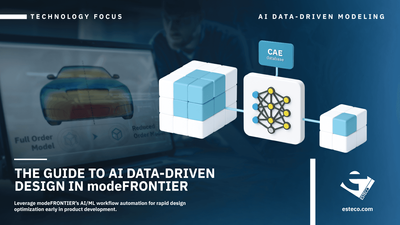
Learn how to use modeFRONTIER’s workflow automation to accelerate design optimization from the earliest stages of product development.
Key challenges in AI data-driven modeling adoption
The cultural gap
Prioritizing metrics like peak performance or a single number over probabilistic distributions is a common practice for engineers. This can make it difficult to envision how ML models solve real-world engineering problems.
Dynamic data and the imperative of governance
ML models have a short lifespan. Train a surrogate model on today's high-fidelity CFD or FEA simulations, and tomorrow new runs generate fresh datasets that demand retraining. Putting the governance over all of the ML stack is a very demanding task.
Infrastructural hurdles to scalable deployment
ML and deep learning requires HPC access that engineers often lack on-premises. With data scattered across locations, teams face tough choices: move massive datasets, risking security and latency or deploy models on limited hardware.
Benefits of ESTECO’s AI data-driven modeling
Capture key problem features accurately and cost-effectively.
Guided approach
Test different ML architectures, including ROM and deep learning.
Lifecycle data governance
Store versioned data and efficiently retrieve AI/ML models relevant to your specific project.
Automated workflows
Move seamlessly from raw data to deployment-ready models.
Real-time simulation analysis
Enable non-experts to run accurate designs faster.
Cost-effective simulation
Use ROM technology to make simulation affordable when full-scale testing is too slow or expensive.
AI-powered design exploration
Run design optimizations directly on ROM models for instant feedback.

Watch and learn how our AI/ML process data approach for engineering design optimization is orchestrated by modeFRONTIER’s workflow.
Scale and democratize AI/ML models with VOLTA
Combine ML data-driven modeling with our simulation process and data management (SPDM) technology to govern your data and run ROM-based simulation evaluations seamlessly. The VOLTA platform bridges the gap between two key roles:
- AI/ML creators: Leverage AI/ML workflow automation technology to generate CAE datasets and train ML models, making them consumable through an intuitive web interface.
- AI/ML consumers: Non-experts can perform ROM-based simulations using a simplified simulation app, delivering real-time design predictions without the need for additional CAE runs.

Scale and democratize MDO workflows with VOLTA
Learn moreFrequently asked questions
Quick answers to questions you may have.
AI data-driven modeling reduces simulation time by replacing repeated heavy simulations with fast predictions.
-
It learns from past simulations
Instead of starting from scratch for every project, AI models use your existing data to learn patterns between inputs and outputs. This allows you to reuse previous computations to inform new designs. -
It creates reliable surrogate models in a short amount of time
AI builds what engineers call surrogate models (or reduced order models). These models approximate the behavior of complex simulations but run in seconds rather than hours. -
It speeds up design exploration
Testing hundreds of variations with full simulations is often too slow for early design phases. AI lets you evaluate thousands of designs almost instantly, making exploration both broader and faster. -
It reduces unnecessary high-fidelity simulations
You no longer need to simulate every single scenario. Use AI for the majority of your iterations and reserve high-fidelity models for validating final candidates. -
It integrates into optimization workflows
By plugging AI models directly into optimization loops (like in modeFRONTIER), each iteration runs faster. This streamlines the entire process from start to finish.
Simple way to think about it:
- Traditional approach → simulate every design → slow
- AI-driven approach → predict most designs → simulate only key ones → fast
The simple takeaway:
traditional approach: simulate every design - slow
AI-driven approach: predict most designs, simulate only key ones - fast
Yes—AI models can significantly reduce the need for full CFD runs, provided they’re integrated into your simulation workflow.
In modeFRONTIER, you don’t replace CFD directly. Instead, you build and use surrogate models inside the workflow. Here’s the typical setup:
- Connect your CFD solver via a workflow node.
- Generate simulation data by running a design of experiments (DOE).
- Train a surrogate model using built-in AI/ML tools.
- Switch the optimization loop to use the surrogate instead of the CFD solver.
Therefore, the heavy simulations happen only at the beginning.
Once your model is trained, modeFRONTIER uses it to:
By following this process, heavy simulations only occur during the initial phase. Once trained, modeFRONTIER uses the model to:
- evaluate new design points instantly,
- run large-scale optimizations,
- explore thousands of design combinations,
- perform sensitivity and trade-off analysis.
All of these tasks are completed without calling the CFD solver for each iteration.
Even in modeFRONTIER, CFD is essential for:
- generating the initial training dataset (DOE phase),
- validating the best designs identified by the AI,
- refining the model if needed.
This makes your CFD usage targeted rather than continuous.
A realistic workflow example:
If you’re optimizing an aerodynamic component:
Step 1 → Run 80–150 CFD simulations (DOE)
Step 2 → Train a surrogate model in modeFRONTIER
Step 3 → Run optimization with thousands of iterations using AI
Step 4 → Validate top 5–10 designs with CFD
The result: you dramatically reduce simulation calls while keeping accuracy under control.
They can be very accurate but they’re never identical to physics-based simulations. You should expect strong correlation, not perfect replacement.
Defining “accuracy” in this context.
In modeFRONTIER, accuracy is measured by how closely predictions align with simulation results.Therefore, you evaluate the model before trusting it.
Because of this, you always evaluate the model’s performance before fully integrating it into your workflow.
What drives accuracy the most?
- Data quality
- Coverage of the design space
- Model choice and training: modeFRONTIER provides multiple surrogate models (e.g., RSM, Kriging, neural networks). Some work better for smooth problems, others for complex nonlinear behavior.
- Problem complexity
How engineers use them safely in modeFRONTIER --> The typical approach is:
- Train the surrogate model.
- Validate it with test data.
- Use it for fast exploration.
- Confirm final designs with full simulations.
By following this process, accuracy is managed, not assumed.
Yes — AI data-driven modeling is particularly effective for multidisciplinary optimization problems when integrated into a platform like modeFRONTIER.
modeFRONTIER allows you to:
- connect multiple solvers for CFD, FEA, thermal analysis and more,
- run a DOE across all disciplines,
- collect a unified dataset,
- train surrogate models (single or multiple),
- run multi-objective optimization using AI.
With this approach you can evaluate complex trade-offs much faster.
ESTECO builds trust in AI predictions by combining validation, transparency, and control — especially within tools like modeFRONTIER.
- Built-in model validation
Before you use any AI model, you validate it against known simulation data.
- Control over the training data
- Which simulations are used.
- How data is cleaned and structured.
- How the design space is sampled (DOE).
This ensures you can trace every prediction back to its source.
- Design space awareness --> modeFRONTIER helps you understand where predictions are reliable.
- Inside the trained design space → high confidence.
- Outside (extrapolation) → lower confidence.
This visibility tells you exactly when to trust the model and when a high-fidelity simulation is required.
- Model comparison and selection --> modeFRONTIER lets you:
- Train multiple surrogate models.
- Compare their performance.
- Select the most accurate one.
This reduces the risk of relying on a poor model.
-
Continuous validation with simulations
-
Workflow transparency and traceability. Every step is visible and reproducible:
- Data source → model → prediction → validation
- Versioning of models and workflows
- Clear audit trail for decisions
- Integration with VOLTA digital engineering platform (for governance)
With ESTECO’s SPDM capabilities, you also get:
- Model lifecycle management
- Version control
- Monitoring of model performance over time
This ensures models stay reliable as new data comes in.
Simple way to think about it --> ESTECO doesn’t ask you to “trust AI.” It gives you tools to:
- Measure it
- Understand it
- Control it.
The takeaway:
ESTECO doesn’t ask you to "trust AI" blindly. We provide the tools to measure it, understand it, and govern it.
Choosing the right algorithm in modeFRONTIER is less about guessing and more about testing what works best for your data. Still, you can narrow it down quickly with a few practical rules.
- Start from your problem type. First, look at what you’re trying to predict.
- Smooth, continuous outputs → simpler models work well
- Highly nonlinear behavior → more flexible models needed
- Noisy data → robust models perform better
- Match algorithms to your data size
- Small datasets (50–200 points)
- Medium datasets (200–1000 points)
- Large datasets (>1000 points)
- Consider model behavior
- Use model comparison (best practice). In modeFRONTIER, you don’t need to choose blindly. You can:
- Train multiple models on the same dataset
- Compare metrics (R², RMSE, error)
- Select the best-performing one
- Check performance, not just metrics
- Think about your workflow.
Simple rule of thumb:
- Start with Kriging (safe default in engineering)
- Compare with 1–2 alternatives
- Choose based on validation results
AI data-driven modeling supports sustainability by helping you design better products with fewer resources, less energy, and less waste—especially when working in modeFRONTIER.
Let’s break it down in a practical way.
- Fewer simulations → lower energy consumption
- Less physical prototyping → reduced material waste
- More efficient designs
- Faster innovation cycles
- Supporting digital twins and long-term optimization
- Smarter use of simulation data
In modeFRONTIER, this translates into:
- Lower computational cost
- Fewer physical tests
- More efficient and sustainable products
Implementing AI in engineering workflows brings clear benefits, but it also comes with a few practical challenges—especially in tools like modeFRONTIER. Here are the main ones you should expect.
- Data quality and availability
- Limited datasets
- Trust and validation
- Integration with existing workflows
- Choosing the right model
- Managing model lifecycle (MLOps)
- Computational and setup cost (initial phase)
- Skill gap and adoption
- Risk of misuse
Bottom line: AI in engineering is powerful, but it requires a structured and controlled approach. Once you address these challenges, tools like modeFRONTIER make AI practical, reliable, and scalable.
Experience VOLTA and modeFRONTIER software
Whether you have a question about our products, licensing options or pricing, our solution experts are here to assist you.